Species matters more than most homeowners expect, because it changes the whole approach. Open paper-comb nests — the gray umbrella shapes hanging under a Falcon Pointe or Avalon porch ceiling — are built by Polistes…
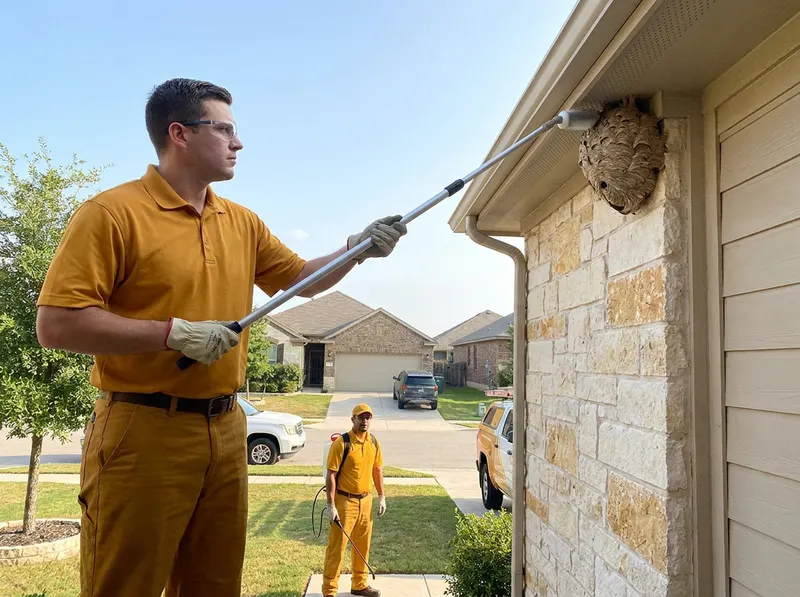
Species matters more than most homeowners expect, because it changes the whole approach. Open paper-comb nests — the gray umbrella shapes hanging under a Falcon Pointe or Avalon porch ceiling — are built by Polistes paper wasps, hold a modest number of adults, and can usually be treated and removed in one visit. Mud daubers leave hard tubes on brick, stone columns and the shaded side of chimneys around Cambridge Estates and Park Place; they're solitary, rarely defensive, and mostly a cosmetic and structural-staining issue. Yellowjackets are the different animal: they nest out of sight in a wall void, a ground burrow, a compost pile or a soffit cavity, they get worse late in summer, and they defend the colony aggressively. If wasps are streaming in and out of a single small hole in siding or a weep joint rather than clustering on a visible comb, that is a void colony and it needs a void treatment — not a can of contact spray aimed at the opening, which mostly pushes the colony deeper or into the living space.
Timing in Travis County is predictable enough to plan around. Queens start small combs in early spring, the nests are barely noticeable in April and May, and by August and September the same nest under a two-story Blackhawk or Highland Park soffit is at peak population and peak temper. That's why the cheap fix works in spring and fails in late summer: a five-cell comb is genuinely easy, a mature nest above a second-floor window is a ladder job with a defensive colony and a real chance of stings. Newer sections of Windermere, Sorento and Commons at Rowe Lane share a common weak point — vinyl or aluminum soffit panels with open ends and unscreened gable vents — and those cavities are exactly what a yellowjacket queen is looking for. Homes backing to greenbelt and the corridor around Lake Pflugerville and the Lake Pflugerville Trail see more traffic from foraging wasps simply because there's more water and more insect prey nearby, and covered patios facing that open space give queens the shade and shelter they want.
Deciding between a single removal and a broader sweep comes down to what the inspection finds. One accessible comb over a garage door, no other activity, no void entry — that's a one-visit job and we'll tell you so rather than sell you more. Multiple nests around the same roofline, or a colony inside a soffit or wall, is a different scope: treatment plus sealing the entry point, screening the vent, or closing the panel end so the cavity stops being available. The trade-off is honest and worth stating plainly — removal alone is cheaper today, and exclusion costs more today but is what actually stops the annual re-nesting on the same three feet of eave. Nothing here auto-renews. A quote is a flat scope for defined work, and if you want a follow-up next spring you call us and ask for it.
Safety questions get straight answers before we start: which product goes where, how long to keep kids and pets off the patio, and what to do about a nest near a hummingbird feeder, a vegetable bed or a dog run. If a nest sits over a walkway to a front door — common on the narrower lots in Springbrook — we'll treat during lower-activity hours and remove the comb rather than leave it hanging to be re-used. Find the entry point. Seal it. That's the whole job, and the price is on the table before anyone climbs a ladder. Call or text (254) 513-9566.
Every job gets a firm, written price after a free on-site visit.
Tell us about your wasp, hornet and paper nest removal job in Pflugerville and we'll send a clear, written quote — usually the same day.
 NexaPath Pest Control Service