Rodents in Pflugerville attics run on a calendar. The first real cold front — usually late October into November — pushes roof rats and mice off the greenbelts and field edges and up into warm insulation. Homes backing…
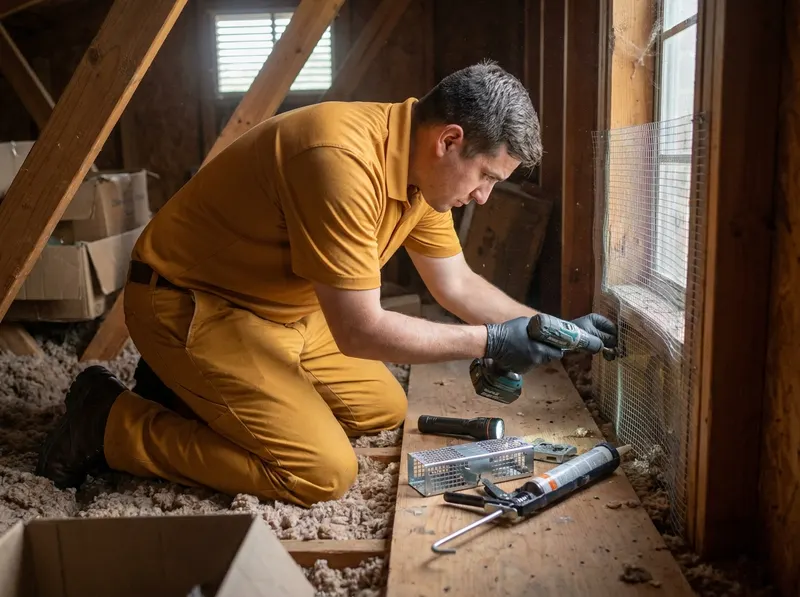
Rodents in Pflugerville attics run on a calendar. The first real cold front — usually late October into November — pushes roof rats and mice off the greenbelts and field edges and up into warm insulation. Homes backing the open ground around Commons at Rowe Lane and the pasture edges near Rowe Lane itself see it first, along with anything shaded by mature live oaks or cedar elms in Highland Park and Windermere, where limbs touching the fascia give roof rats a bridge straight to the roofline. Newer builds in Falcon Pointe, Avalon and Sorento aren't exempt: fresh construction leaves reliable gaps where soffit meets brick and where the builder's dryer vent flap never fully closes. A mouse needs a hole the size of a dime. A rat needs a quarter.
The diagnosis matters more than the trap count. Scratching after dark, droppings along attic joists, greasy rub marks on framing, and chewed insulation over a specific room all point to an established population rather than one wanderer. One rodent that got in through a propped garage door is a different job from a family nesting over the master bedroom. We inspect the attic and then walk the exterior at ground and roof level, because the entry point is almost always outside — and it's almost never where the noise is. We give you the list before anything gets sealed.
Trapping-only makes sense in a narrow set of cases: a rental turnover with a closing date, a single garage sighting, or a slab-level mouse issue with no attic activity. It costs less up front. The trade-off is honest — if the opening stays open, the attic repopulates, often in the same season. Full exclusion costs more once and is the only version of this work that changes the outcome. We also don't seal first and trap later; sealing a live population inside a wall creates a worse problem than the one you called about. Traps come out first, then the openings close.
Safety is a fair question with rodent work. Snap traps in an attic sit far above pet and child reach, and exclusion is mechanical — hardware cloth, sheet metal, mortar and sealant, not bait scattered around a yard your kids and dogs use. Homes near Lake Pflugerville and the trail loop, where families are in and out of the backyard year-round, get the same physical-barrier approach. If bait stations are ever appropriate outside, they're tamper-resistant and their placement is shown to you before installation, not after.
We stay local to Pflugerville and the surrounding Travis County neighborhoods — Blackhawk, Springbrook, Park Place, Cambridge Estates — which is why we can tell you what a 2006 roofline in your subdivision usually looks like before we set the ladder. Call (254) 513-9566 and we'll come look. Find the entry point. Seal it.
Every job gets a firm, written price after a free on-site visit.
Tell us about your rodent trapping and attic exclusion job in Pflugerville and we'll send a clear, written quote — usually the same day.
 NexaPath Pest Control Service