German cockroaches are the one Pflugerville pest that almost never comes from outside. They arrive in a cardboard box, a secondhand microwave, a grocery bag, or through a shared wall in a duplex — then stay indoors…
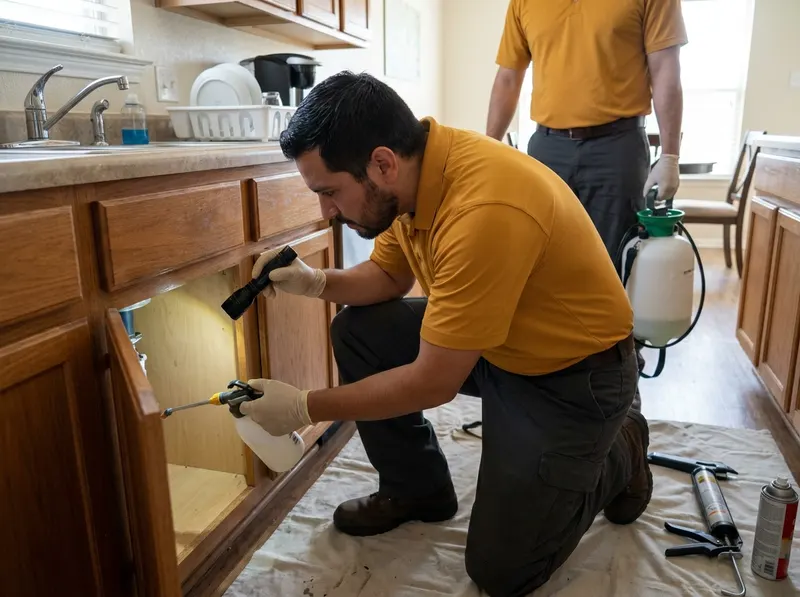
German cockroaches are the one Pflugerville pest that almost never comes from outside. They arrive in a cardboard box, a secondhand microwave, a grocery bag, or through a shared wall in a duplex — then stay indoors year-round, which is why they show up the same in a 2006 Highland Park home as in a newer build off Rowe Lane. If you flip on the kitchen light and see small tan roaches with two dark stripes behind the head scatter toward the dishwasher, that is a German cockroach and it means there is a harborage within a few feet. Larger, reddish-brown roaches wandering in from the garage after rain near Lake Pflugerville are usually American cockroaches, and those are a different, simpler job. Naming the species correctly changes the entire treatment plan, so the inspection comes first.
A cleanout fits when you are seeing roaches during daylight, finding pepper-like droppings inside cabinet corners, or spotting shed skins and empty egg cases behind the toaster. At that stage the population is established and store-bought foggers make it worse — the repellent push scatters nymphs deeper into wall voids and into neighboring units in Avalon and Springbrook townhome-style layouts. The alternative to a cleanout is a standard general pest service, which handles ants, spiders, and the occasional scorpion along the exterior but does not concentrate bait where German cockroaches actually feed. The trade-off is honest: a cleanout costs more up front and asks more of you, because it works best when cabinets under the sink are cleared and dishes are not left overnight for two weeks. In exchange, it addresses the colony instead of the ones you can see.
Our method leads with diagnosis. We map harborage points, then place gel bait in the tight, protected spots roaches travel — cabinet hinge voids, the gap behind the sink basin, the underside of a dishwasher frame, the seam where a countertop meets the backsplash. Baits are non-repellent by design, so nymphs carry the active ingredient back to the harborage. An insect growth regulator goes in alongside it to stop the next generation from reaching breeding age, which is the piece most DIY attempts skip and the reason infestations rebound in six weeks. Monitors left behind give a real count, and the follow-up visit roughly two to three weeks later catches the hatch that was still inside an egg capsule on day one.
Landlords with rentals near Stone Hill Town Center and Park Place should know that adjoining units matter. German cockroaches move through shared plumbing chases and outlet penetrations, so treating one side of a duplex while the other goes untouched usually means reinfestation. We will tell you that on the walkthrough instead of after the invoice. Product placement is deliberate about safety too — gels and dusts go into voids and crevices out of reach of pets and children rather than being broadcast across open floors, and we walk you through re-entry timing before we start. Find the entry point, seal it, and break the cycle: for German cockroaches that means bait, an IGR, and sanitation discipline in Travis County kitchens, not a bigger can of spray.
Every job gets a firm, written price after a free on-site visit.
Tell us about your german cockroach cleanout job in Pflugerville and we'll send a clear, written quote — usually the same day.
 NexaPath Pest Control Service