Pflugerville sits on Blackland Prairie clay, and that soil is the reason termite inspections here look different than they do on sandy ground. Clay swells when Wilbarger Creek and the Lake Pflugerville watershed get a…
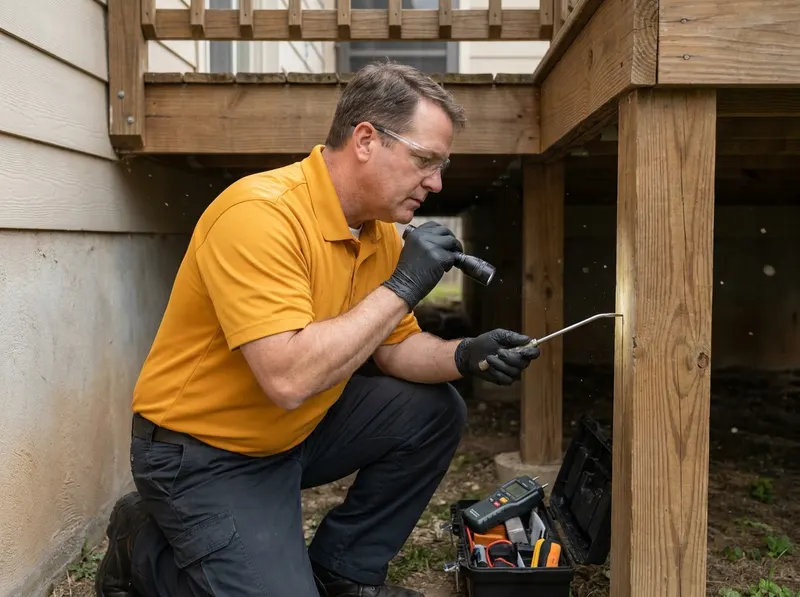
Pflugerville sits on Blackland Prairie clay, and that soil is the reason termite inspections here look different than they do on sandy ground. Clay swells when Wilbarger Creek and the Lake Pflugerville watershed get a heavy spring rain, then shrinks hard in an August dry spell. That cycle opens hairline separations along slab edges, around plumbing penetrations, and behind brick weep lines — which is exactly the protected, moist path subterranean termites use to reach untreated wood. Termites almost never enter through open air; they enter through a soil-contact gap you cannot see from standing height. So the inspection starts on hands and knees at the grade line, not with a spray wand.
Subdivision age changes what we expect to find. In Windermere and Highland Park, older landscaping has often grown up against the foundation, irrigation heads soak the same three feet of soil daily, and mulch beds sit above the slab line — the three conditions that produce the most confirmed activity we look for. In newer slab-on-grade sections like Falcon Pointe, Avalon, Sorento, Commons at Rowe Lane, and Park Place, the more common findings are construction-related: form boards left in place, stucco or siding buried below grade, and expansion joints that were never sealed. Blackhawk, Springbrook, and Cambridge Estates fall in between, and backyard structures — pergolas, raised beds, and fence posts set directly in clay — are frequently where activity shows up first, well before anything reaches the house.
When an inspection is the right call instead of a treatment quote: you saw winged insects near a window in February or March, you found a thin dirt line running up interior sheetrock or a garage wall, a home inspector flagged "possible WDI evidence," or you are buying and need the wood condition documented before you sign. In those cases, diagnosis first is cheaper and more accurate than committing to a treatment scope. The alternative — going straight to a full perimeter treatment — makes sense only after activity and its entry route are actually confirmed, because treating the wrong side of a house is a real and expensive way to keep the problem. The trade-off is honest: an inspection costs money and may conclude that nothing active is present. Many Pflugerville homeowners consider that a good outcome, and it gives you a baseline to compare against next spring.
Swarmer season in Travis County generally runs late February through May, usually within a day or two of a warm rain, and that is when the phone gets busy. If you find a pile of translucent wings on a windowsill after a storm, save a few in a sandwich bag — identification is faster with a specimen, because termite swarmers and the flying ants you see near Pfluger Park and along the Lake Pflugerville Trail get confused constantly. If your inspection is tied to a lender, buyer, or closing date, tell us at booking so we can confirm exactly which report format the transaction requires before we schedule. If treatment or exclusion work is warranted, you get the scope and a flat price in writing, and you are free to take it elsewhere. Find the entry point. Seal it.
Every job gets a firm, written price after a free on-site visit.
Tell us about your termite and wood-destroying insect inspection job in Pflugerville and we'll send a clear, written quote — usually the same day.
 NexaPath Pest Control Service