The scorpion in Central Texas is almost always the striped bark scorpion, a night hunter that climbs, flattens itself into gaps roughly the width of a credit card, and shelters in dark, tight, temperature-stable…
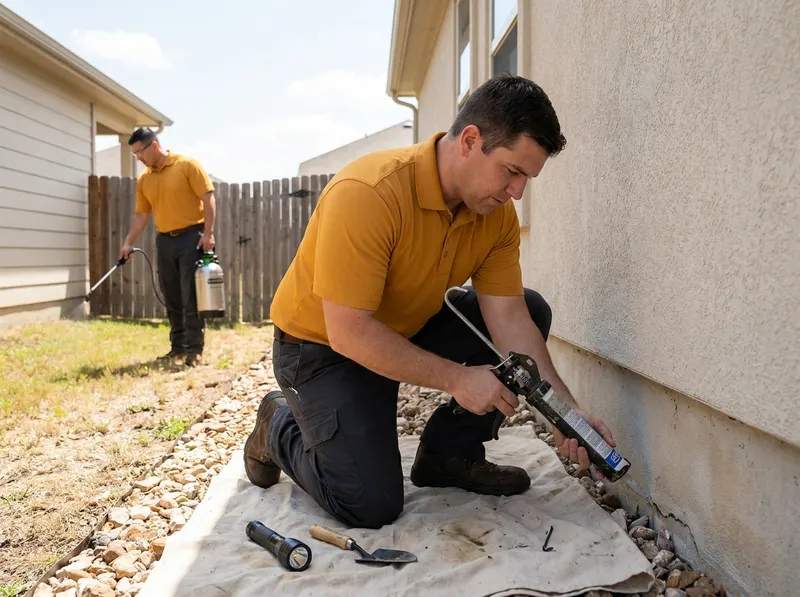
The scorpion in Central Texas is almost always the striped bark scorpion, a night hunter that climbs, flattens itself into gaps roughly the width of a credit card, and shelters in dark, tight, temperature-stable places. That is why the classic Pflugerville sighting is a scorpion on cool bathroom tile, in a bathtub, on an upstairs baseboard, or on a garage floor at 11pm — not out in the open in the middle of the day. A scorpion indoors is a structural gap problem before it is a chemical problem. We inspect for the route first: weep holes in the brick veneer, the gap under a garage door where the seal has hardened and curled, the sleeve around a hose bib or refrigerant line, the plumbing penetration behind a tub, attic soffit and gable openings, and the expansion joint where the slab meets the driveway.
Pflugerville sits on Blackland Prairie clay, which shrinks and cracks hard through a dry July and August. Those cracks open pathways along the slab edge, and scorpions follow them toward cooler, moister ground — often straight under a foundation. Newer east-side subdivisions built on former pasture, including Falcon Pointe, Commons at Rowe Lane, Sorento and Avalon, tend to have tight construction but heavy decorative rock, fresh landscape stone and young trees, which is prime daytime harborage. Older streets in Windermere, Highland Park and Park Place more often show settled slabs, aged door sweeps and gaps at utility entries, so the sealing list there is usually longer than the treatment list. Homes backing greenbelt and creek corridors near Pfluger Park, or along the rock-edged sections of the Lake Pflugerville Trail, get steady pressure from the outside all summer — those properties benefit most from a wide exterior barrier plus sealing rather than interior spraying.
Choose scorpion control with perimeter sealing when you have seen more than one scorpion, or seen one indoors above the ground floor. A single scorpion in a garage right after a storm may genuinely be a one-off, and we will say so. Repeat sightings in Blackhawk, Springbrook or Cambridge Estates upstairs bathrooms usually mean there is an established route through the wall void or attic, and no amount of exterior spray fixes a route. The trade-off is honest: sealing costs more on day one than a spray-only visit, and it takes longer. What it buys is fewer repeat visits, because the gap is closed permanently instead of chemically discouraged for a few weeks. If your concern is broader than scorpions — ants, roaches, rodents — our homepage lays out how those services differ, and combining scope on one visit usually costs less than booking separately.
On products and timing, we tell you exactly what is applied, where it goes, and how long to stay off treated surfaces before anyone or any pet uses the area again. Most exterior treatment is placed at the foundation line, in cracks, and in harborage away from garden beds and play areas, and we will work around a vegetable bed or a dog run if you point it out during the walkthrough. Sealing work is documented so you can see each opening that was closed. We also give you the maintenance items that matter here: keep firewood and construction leftovers off the ground and away from the wall, pull rock and mulch back a few inches from the slab, and replace hardened weatherstripping before scorpion season ramps up in May. Pressure from the greenbelt does not stop, so the point is to keep the house sealed against it.
Every job gets a firm, written price after a free on-site visit.
Tell us about your scorpion control and perimeter sealing job in Pflugerville and we'll send a clear, written quote — usually the same day.
 NexaPath Pest Control Service